Public School Policies

From unions to vouchers, school budgets to discipline policies, we cover some of the most controversial issues affecting public schools today. Learn more about education reform and how it impacts your family. Keep current on the latest controversies regarding religion, sex-education, civil rights and more.

View the most popular articles in Public School Policies:

The Drama of Teacher Ratings: From a Suicide to Lawsuits

Updated
|
The Drama of Teacher Ratings: From a Suicide to Lawsuits
The reform in education has prompted a movement to rate teachers, which has generated its fair share of support and criticism. Learn about the controversy, lawsuits, and even a tragic suicide stemming from publicly released teacher ratings.

The debate over teacher evaluations has been raging for some time, with discussion over how to rate teachers in very different communities with very different student demographics by the same basic criteria. One solution that has been effectively used across the country is value-added analysis, which pits teacher performance against specific student expectations. While many agree that value-added analysis is the best system to gauge teacher performance today accurately, another conflict has been brewing – whether to make these evaluations accessible to the general public.

What is Value-Added Analysis?

According to an article at National Public Radio, value-added analysis is "a method for calculating teacher effectiveness based on how the teacher's students perform on standardized tests." Instead of strictly looking at the scores, however, these evaluations consider the expectations for the students based on 30 factors, including the students' ethnicity and whether they are poor enough to qualify for a free lunch. This methodology more accurately compares the performance of teachers who teach to different populations of students.
In addition to value-added analysis, most teachers are evaluated by a "soft" criterion, which tends to be more subjective. This might include classroom observations by the principal, student papers, and project evaluations. The data compiled on teachers through these evaluations has been historically kept private by the school district and used strictly by administrators for developing classroom strategies and managing a teacher's personal career track. However, that changed when the Los Angeles Times published teacher

. . .read more

Dangerous Dodge Ball: 4 Lawsuits Stemming from P.E.

Updated
|
Dangerous Dodge Ball: 4 Lawsuits Stemming from P.E.
Physical education could mean much more than scrapped knees and bruised egos from being picked last. Learn about four lawsuits involving physical education that range from fights to even a tragic death.

Ask any elementary-aged child what their favorite school subject is and many will either say recess or P.E. Children delight in the opportunity to run, play and compete with other students after sitting in math and language arts for most of their day. Unfortunately, that time in the school gym or on the playground isn't always the safest from a parent's perspective. We have a rundown on a number of lawsuits pending in school districts across the country, due to what has been perceived as unsafe conditions.

In this video, an attorney explains your options.

Tucson School Sued over Fight

A simple game of tag on a school playground during a physical education class landed one Tucson student in the hospital, according to a report at AZ Central. The student, a 10-year-old Cody Barber, claims that he was attacked by another student during a game of tag at his elementary school in the Tucson Unified School District. The attacker allegedly knocked Cody to the ground and then kicked him once. Barber's spleen was severely lacerated, which required surgery and six days at a nearby medical center to repair.

Barber's mother has accused the school district of negligence in the injury of her son because she said the alleged attacker had a known history of behavioral issues and had been placed "on restriction" by the school. This

. . .read more

Is a Michigan Teacher Being Punished for Defending Homosexuals?

Updated
|
Is a Michigan Teacher Being Punished for Defending Homosexuals?
Jay McDowell, a public school teacher in Howell, evicted a student for making anti-homosexual comments, but now the instructor faces suspension. Learn about the national controversy that involves this local Michigan teacher.

Most educators and parents would agree that school needs to be a safe place if children are to successfully learn. However, what that safe place looks like has become a topic of controversy for one Michigan school district. On the one hand, a teacher is being applauded for standing up for homosexual students. On the other hand, that same teacher is being accused of bullying students who voiced their own views on anti-homosexuality based on their religion. Which stand is correct? The verdict is still out.

In 2026, debates surrounding student speech, religious expression, LGBTQ+ protections, and school safety policies continue to play out in school districts across the country. Public schools are still navigating how to balance student rights in public school with anti-bullying policies and inclusive learning environments.

The Howell Controversy

In a high school about 45 miles northwest of Detroit, a school teacher asked one of his economics students to remove a belt buckle that featured the Confederate flag. The teacher, Jay McDowell, explained that the symbol could be offensive to some of the students in the class. The student readily complied with the request, but the exchange sparked a discussion among other students and the teacher that resulted in two students being asked to leave the classroom.

The first student, 16-year-old Daniel Glowacki, asked McDowell to explain the difference between the Confederate flag and the rainbow flag that serves as a symbol of pride for the gay community. At the time, McDowell

. . .read more

Public School Choice: Dispatches from LAUSD's Reform

Updated
|
Public School Choice: Dispatches from LAUSD's Reform
The LA Unified School District is hoping that the Public School Choice reform can turnaround ailing schools. How well is it working thus far?

What do you do with a school that consistently fails to maintain quality standards in educating students? Some school districts might opt to pull funding or close the school down completely. However, Los Angeles Unified School District launched a very different idea through Public School Choice reform, which allowed other educational entities to take over struggling schools in an effort to produce institutions that achieved stronger academic results through innovation and autonomy.

Schools that did not make the grade each year were put on the eligibility list for Public School Choice reform. At that time, nonprofits, teachers, or charter operators could apply to revamp struggling campuses. These entities could choose to operate separately from the school district, or they could work within district guidelines to produce a brand-new educational system specifically geared to that school and the children who attend.

While the original initiative has changed over time, Los Angeles Unified School District still describes the Public School Choice initiative as part of its work with schools and partners. The Intercultural Development Research Association describes school choice as a concept that can include controlled choice plans within a single public school district, interdistrict and statewide public school plans, and voucher plans that include private schools.

For additional background, parents can also read Public School Choice, Magnet Programs & Charter Options: What’s Best?.

Why Public Choice?

According to the original Public School Review article, the Public School Choice motion was designed to tap into

. . .read more

Is Your Public School Fairly Funded? View the Report

Updated
|
Is Your Public School Fairly Funded? View the Report
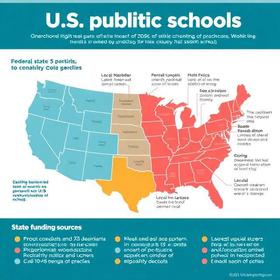
This article examines a national report on public school funding fairness across states, highlighting disparities in funding allocation, especially for high-poverty districts. It discusses the impact of funding on education quality and the need for equitable distribution to support disadvantaged students.

Is Your Public School Fairly Funded? View the Report

One of the primary factors used to assess the quality of public education in our country is the amount of money that is pumped into the educational system by individual states. In light of President Obama's nationwide contest for funding, dubbed "Race to the Top," funding of public schools has become of even greater interest.

A recent study of school funding found that while a handful of states do reasonably well in getting funding to the districts that need it most, others are sorely lacking, putting low-income students at an even bigger disadvantage when it comes to their education and future.

This TEDTalk looks at the dilemma of public school funding.

About the Study

The recent study "Is School Funding Fair? A National Report Card," was authored by David Sciarra, executive director, and Daniel Farrie, research director, of the Education Law Center in New Jersey, and Bruce Baker of Rutgers University Graduate School of Education.

The report looked at all 50 states and rates school funding fairness on the following factors:

  • Funding level
  • Funding distribution
  • State fiscal effort
  • Public school coverage

The report uses a detailed analysis of these factors to determine which states exercised equality in their funding efforts, assuring that the school districts that needed the funding most were the top priority for their states.

According to a report in Daily

. . .read more

Recent Articles

How Public Schools Train Staff Each Year
Learn how public schools train staff each year through professional development, safety training, technology instruction, and ongoing educational support.
What Substitute Teachers Experience in Public Schools
Discover what substitute teachers experience in public schools, including daily responsibilities, challenges, rewards, and their role in student success.
How Teachers Collaborate Across Departments in Public Schools
Learn how teachers collaborate across departments to improve student outcomes, strengthen instruction, and prepare students for real-world success.

Public School Policies

EDUCATION REFORM
Education reform is in the works, and you can stay updated on the latest changes, debates, and policies here. Learn more about No Child Left Behind and how it impacts your child. Explore how federal and state government is working to improve school performance, student achievement and education standards.
TEACHERS AND UNIONS
A comprehensive look at teachers, tenure, and unions. Learn how unions impact school performance. Explore the impact of education reform on teaching qualification standards, traditional unions and controversial tenure rules.
PUBLIC SCHOOL BUDGETS
We offer an overview of public school budgets; where the money comes from, how it’s spent and what schools are doing to get more funding. Learn how schools are cutting budgets and how the cuts will impact your child. Delve into some of the creative ways school districts are trying to raise money and where the extra money is spent.
VOUCHERS
Explore both sides of the school voucher debate. Learn what your options are, how those choices are funded and the impact on your local school district. From the latest government initiatives to results from recent studies, explore vouchers and the options they provide.
SCHOOL DISCIPLINE POLICIES
Examine the various discipline methods being put to use in public schools. From detention to expulsion, spanking to handcuffing, school discipline can often be controversial. Does spanking work? Do police belong in schools? Learn more about what is being done to punish out of control students.
SCHOOL CONTROVERSIES
The most controversial issues impacting public school students today. From bullying to book bans, this is a comprehensive look at some of the most oft-debated issues. This section features articles on school segregation, religion, over-crowding, civil rights, and green technology.