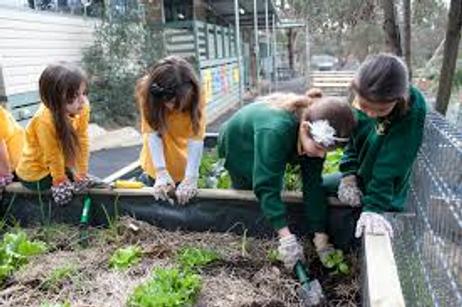
Public school gardens have been sprouting across the country, especially in California, which is the home state of culinary pioneer and “slow food” spokeswoman Alice Waters. As a champion of local agriculture, Waters inspired one of the first school gardens in Berkeley, California, and many public school campuses have followed in these green footsteps.
However, a fierce debate over the merits of public school gardens erupted following an article in The Atlantic by Caitlin Flanagan that criticized the practice of devoting class time in public schools to the cultivation of school gardens. Flanagan argued that by allowing students to spend school hours working in a garden, schools may do students a disservice academically. She reminded readers that California's public school system has long struggled with achievement gaps and graduation challenges. When a state's public school system is failing to meet the academic needs of its students, should it spend time and resources on a school garden program?
Flanagan's anti-garden argument was not taken lightly by those who count themselves as advocates of school gardens. Her article sparked responses from both sides of the debate, forcing parents and teachers to clarify their positions on this now controversial topic.
Families interested in how schools are expanding hands-on learning may also want to read Public School Review’s article on What Is Project-Based Learning?.
Garden Advocates
Tending a garden helps students learn to make better food choices
Cultivating a garden teaches students about fruits and vegetables, helping them become more comfortable and familiar with fresh produce. Supporters argue that this increases the chances that students will incorporate healthier foods into their diets instead of relying heavily on processed foods and fast food.
The Centers for Disease Control and Prevention continues to support nutrition education and healthy eating initiatives among children.
Gardens can be used to explore a variety of academic subjects
Those who support public school gardens say gardening can supplement lessons in a wide variety of subjects. On the blog Civil Eats, Kurt Michael Friese wrote, “There is nothing taught in schools that cannot be learned in a garden.”
Teachers often incorporate gardens into science, environmental studies, nutrition, writing assignments, and mathematics lessons. In 2026, many schools also use gardens to support sustainability education and climate awareness initiatives.
Readers may also enjoy Public School Review’s article on Are Public Schools Protecting the Environment?.
Gardens teach important life skills and values
Some educators believe tending a garden helps students learn teamwork, responsibility, patience, and perseverance. These character-building lessons may also support students socially and emotionally while reinforcing collaborative learning.
Learning to eat well is an important part of being a good citizen
Learning how to be a responsible and productive citizen should involve learning how to make wise food choices, according to garden supporters. Andrew Leonard wrote in Salon that advocates believe “understanding what we eat is an essential ingredient in understanding how to live well, healthily and sustainably.”
In recent years, schools have increasingly tied gardens to broader discussions about food systems, sustainability, and local agriculture.
Garden Naysayers
Teaching manual labor should not be the educational system's goal
Flanagan argued that devoting instructional hours to the care of a school garden wastes valuable academic time. She asked readers to consider migrant farmworkers who send their children to school, hoping education will provide opportunities beyond agricultural labor.
Critics question whether students should spend instructional time gardening when schools continue facing challenges in literacy, math proficiency, and graduation rates.
No proof that gardens help students succeed academically
Flanagan noted that she found little concrete evidence proving that gardens significantly improve academic performance.
While some recent studies suggest gardens may increase engagement and student participation, research remains mixed regarding long-term academic outcomes. According to the National Farm to School Network, schools continue studying how garden programs affect attendance, nutrition, and academic achievement.
Takes time away from pressing academic concerns
California remains one of the strongest supporters of public school gardens, and many schools maintain gardens of some type. However, debates over academic priorities continue.
Supporters believe gardens enrich education, while critics argue schools should focus more heavily on improving standardized test scores, literacy rates, and graduation outcomes before expanding nontraditional programming.
Re-Examining Curricular Choices
Few educational topics generate as much passionate disagreement as public school gardens. While many educators disagree with Flanagan’s conclusions, the debate has encouraged schools, curriculum designers, and administrators to more carefully examine how instructional time is used and how experiential learning fits into broader academic goals.
As public education continues evolving in 2026, school gardens remain both a symbol of innovative learning and a reminder that schools must continually balance enrichment opportunities with academic accountability.
Conclusion
Public school gardens continue to spark debate because they sit at the intersection of academics, health, sustainability, and experiential learning. Supporters see them as valuable educational tools that teach life skills and healthy habits, while critics question whether they distract from core academic priorities. In 2026, many schools are working to find a balance, using gardens to complement classroom instruction without losing focus on student achievement and educational outcomes.