
History of Public Schools

A History of Public Schools in America (2026 Update)

Updated
|
A History of Public Schools in America (2026 Update)
Explore the history of public schools in the U.S., from early beginnings to modern reforms, with key milestones and 2026 insights.

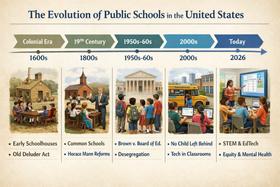
Understanding the history of public schools offers valuable insight into how today’s education system evolved and where it is headed. From informal colonial classrooms to a nationwide system serving over 49 million students, public education in the United States reflects the country’s social, political, and economic transformations.

This updated look at the history of public schools traces key milestones, influential reforms, and modern developments shaping education in 2026.

Early Foundations: Education in Colonial America

The roots of public education in America date back to the 17th century. Early schools were often locally organized and funded, primarily to promote literacy for religious purposes.

In 1647, Massachusetts passed the “Old Deluder Satan Act,” requiring towns to establish schools so children could learn to read the Bible. While not “public schools” in the modern sense, these institutions laid the groundwork for community-supported education.

Key characteristics of early schooling included:

  • Limited access, often restricted to white males

  • Strong religious influence

  • Local funding and control

  • Basic curriculum focused on reading, writing, and arithmetic

Education was not yet considered a universal right. That idea would emerge much later.

The Common School Movement: A National Vision Emerges

The early 19th century marked a turning point with the rise of the Common School Movement, led by reformers like Horace Mann. These advocates argued that education should be:

  • Free and publicly funded

  • Universal and accessible to all children

  • Nonsectarian

  • Taught by trained teachers

Massachusetts became a model for other states, establishing tax-supported public schools and

. . .read more

Understanding the U.S. Department of Education: Structure, Impact, and Evolution

Updated
|
Understanding the U.S. Department of Education: Structure, Impact, and Evolution
We explore how the Department of Education shapes American education, from its cabinet-level leadership to its impact on millions of students, written for general audiences seeking clarity on this vital institution.

Understanding the U.S. Department of Education: Structure, Impact, and Evolution

The U.S. Department of Education stands as a cornerstone of American education, yet many citizens remain unclear about its actual role and impact. This exploration breaks down the department's structure, functions, and significance in shaping educational opportunities for millions of Americans, offering clarity on how this federal agency works alongside state and local authorities to support education nationwide.

What is the U.S. Department of Education?

The Department of Education (ED) is a cabinet-level federal agency established in 1979 that oversees education policy and federal assistance to education in the United States. With approximately 4,400 employees and an annual budget of $79 billion, it is the smallest cabinet-level department.

Why Does the Department of Education Exist?

The Department of Education Organization Act of 1979 established the modern Department of Education with specific purposes that addressed critical needs in American education.

Equal Educational Opportunity

The primary purpose was to strengthen federal commitment to ensuring equal access to education for every individual. This emerged from the recognition that local control of education had sometimes resulted in disparate educational opportunities, particularly for minorities, students with disabilities, and economically disadvantaged students. The Supreme Court's landmark Brown v. Board of Education decision had established that education "is perhaps the most important function of state and local governments" and must be made available to all on equal terms.

Supporting State and Local Education

Congress recognized

. . .read more

Segregation in K-12 Education: Post-Revolutionary War Era (1776-1865)

Updated
|
Segregation in K-12 Education: Post-Revolutionary War Era (1776-1865)
Step into the Post-Revolutionary War Era and explore the landscape of education in America during this transformative period. Journey through the tumultuous Reconstruction Era, a time of hope and immense challenges in the wake of the Civil War. Discover the resilience and determination of marginalized communities in establishing independent schools and advocating for educational equality amidst the challenges of this pivotal time in American public education.
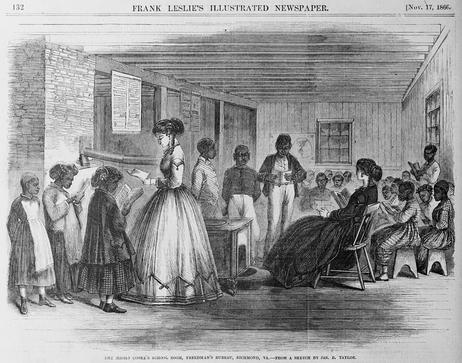
Photo by Jas. E. Taylor., Public domain, via Wikimedia Commons

Segregation in K-12 Education: Post-Revolutionary War Era (1776-1865)

Segregation in K-12 education has been a persistent issue throughout American history, with its roots tracing back to the Colonial Era. This essay examines the origins of segregation in K-12 education during that time and explores the differential treatment experienced by Native American, African American, and white students. By delving into the historical context and citing relevant sources, we can better understand how educational disparities based on race and ethnicity were established and perpetuated.

The Post-Revolutionary War Era marked a critical period in American history when the foundations of segregation in K-12 education were solidified. This essay delves into the historical context of this era and explores the consolidation of racial disparities in education. By examining the policies, attitudes, and events that shaped educational segregation, we can gain insights into the enduring consequences of this era.

The transition from Colonial to State Control

The Emergence of State Control over Education

With the end of the Revolutionary War, control over education shifted from colonial and religious institutions to state governments. This transition facilitated the consolidation of power in shaping educational policies.

Early State Laws and Segregated Education

Many states enacted laws during this era that explicitly segregated education based on race. For example, Massachusetts passed a law in 1789 requiring the establishment of racially separate schools, perpetuating educational disparities.

......................................................................................................................................................................................................................................

Expanding Racial Disparities in Education

Limited Educational Opportunities for African-American Students

African-American students faced severe limitations in accessing formal education.

. . .read more

Segregation in K-12 Education: The Jim Crow Era

Updated
|
Segregation in K-12 Education: The Jim Crow Era
This article delves into the segregated schooling system that existed during the Jim Crow Era, examining the disparities faced by African American students.

Segregation in K-12 Education: The Jim Crow Era

This second in my series of articles about K-12 segregation covers The Jim Crow Era from 1877 to 1954, a dark time in American history characterized by widespread racial segregation and discrimination. This essay explores the historical context of the Jim Crow Era and its impact on K-12 education. By analyzing the policies, legal decisions, and struggles faced during this era, we can gain insights into the challenges and resilience of individuals and communities in the fight for educational equality.

Step back in time and delve into the dark period of American history known as the Jim Crow era, where racial segregation pervaded all aspects of society, including education. We'll look into the segregated schooling system that existed during this time, examining the disparities faced by African-American students. Explore the historical context, discriminatory policies, and the impact on educational opportunities for marginalized communities. Uncover the struggles, resilience, and pivotal legal battles that ultimately paved the way for progress in dismantling segregation. Gain insights into the enduring legacy of this era and its implications for the fight for educational equality in the present day.

......................................................................................................................................................................................................................................

Legalization of Racial Segregation

Plessy v. Ferguson and "Separate but Equal"

The Supreme Court's 1896 decision in Plessy v. Ferguson established the "separate but equal" doctrine, endorsing racial segregation in public facilities, including schools. This ruling legitimized the practice of segregated education.

Plessy v. Ferguson was a landmark

. . .read more

Segregation in K-12 Education: Colonial Era

Updated
|
Segregation in K-12 Education: Colonial Era
Explore the origins of educational segregation during the colonial era and the differential treatment of Native American, African American, and white students. This article delves into the historical context, policies, and societal attitudes that shaped early education in colonial America, highlighting the disparities and injustices that persisted within the schooling systems of that time.

Segregation in K-12 Education: Colonial Era

Segregation in K-12 education has been a persistent issue throughout American history, with its roots tracing back to the Colonial Era.

  • This essay examines the origins of segregation in K-12 education during that time and explores the differential treatment experienced by Native American, African American, and white students.
  • By exploring the historical context and citing relevant sources, we can better understand how educational disparities based on race and ethnicity were established and perpetuated.

Origins of Segregation in K-12 Education

  • The establishment of formal education in the American colonies laid the foundation for the early seeds of segregation.
  • Native American and African American students were systematically excluded from the educational opportunities provided to white students.

Latin Grammar Schools and Exclusion of Non-White Students

  • The Latin Grammar Schools, prevalent in the Colonial Era, primarily served white male students of privileged backgrounds.
  • Native American and African American students were systematically excluded from these institutions due to societal norms and discriminatory practices.

Lack of Formal Education for Native American Children

  • Native American children faced limited access to formal education during the Colonial Era.
  • Instead, they were often educated within their tribes or subjected to assimilationist boarding schools that aimed to eradicate their cultural identities.

Denial of Education for Enslaved African Americans

  • Enslaved African Americans were denied access to education through deliberate policies and slave codes.
  • Education was seen as a threat to the institution
. . .read more

Recent Articles

Helping Children Overcome First-Week School Anxiety
Learn practical strategies to help children overcome first-week school anxiety, with expert-backed tips for parents and educators.
Public School Immunization Requirements 2026–2027
Learn public school immunization and health requirements for 2026–2027, including vaccines, exemptions, and state policy updates.
Public Schools in a Minute: 2026 Snapshot Guide
A clear 2026 snapshot of public schools in the U.S., including enrollment, funding, trends, and what families should know.