Public School Policies

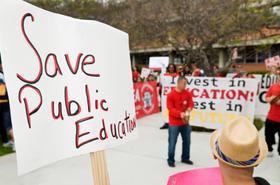
From unions to vouchers, school budgets to discipline policies, we cover some of the most controversial issues affecting public schools today. Learn more about education reform and how it impacts your family. Keep current on the latest controversies regarding religion, sex-education, civil rights and more.

View the most popular articles in Public School Policies:

New California Law Addresses Issue of School Fees Once Again

Updated
|
New California Law Addresses Issue of School Fees Once Again
A new law recently went into effect in California that prohibits schools from charging exorbitant fees for various incidentals in schools like uniforms and field trips. It also provides a path for parents who believe school fees are unfair and in violation of state regulations.

The right to a free public education has been hotly contested in California public schools in recent years. The addition of multiple fees for classroom and extracurricular activities has created a serious financial quandary for many families in the state. As a result, state lawmakers have passed a new law that addresses the issues of high fees, which include guidelines on the fees that can be required and how to help low-income families participate. Unfortunately, the law so full of good intentions has created a whole new set of problems for parents, students and school staff.

The Problem with School Fees

Issues with school fees have been reported by parents and students in the California school system for some time. An investigation by the ACLU in 2010 revealed that many schools were requiring students to purchase workbooks, textbooks and other essentials in school districts across the state. Investigators also discovered that students who were unable to pay were sometimes singled out from the rest of their classmates, according to a report at the Los Angeles Times.

In some of those cases, students were told to shell out hundreds of dollars for graphing calculators, athletic uniforms – even uniforms required for physical education classes at the school. Although many of these fees had previously been ruled illegal in litigation, schools were continuing to assess them. They were presenting a particular hardship for low-income students, who either had to go without important supplies or activities or

. . .read more

Is Prayer Coming Back to Public Schools?

Updated
|
Is Prayer Coming Back to Public Schools?
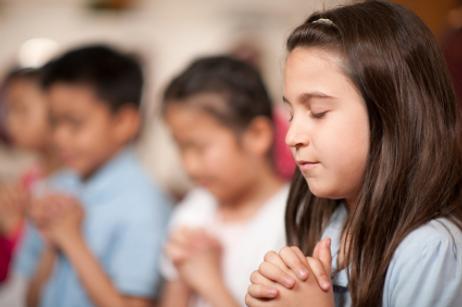
We report on new legislation in Mississippi that allows students to pray publicly in their schools across the state. Now, schools must develop policies to allow for prayer – but the new law is loaded with controversy.

Prayer appears to be on its way back to public schools after a hiatus due to a 2000 decision by the U.S. Supreme Court prohibiting student-led prayers over public address systems at school events. Thanks to a new law in Mississippi, schools will need to adopt a policy that allows for student-led prayer in a variety of venues. While the law has been applauded by many, it has also received plenty of opposition, as well as hints at a future lawsuit.

Governor Puts Signature on School Prayer Law

The New York Times reports that Mississippi Governor Phil Bryant has signed a new law that allows students in Mississippi schools to pray at school events, over school intercoms, and before school athletic contests. All prayers issued by students must be accompanied by a disclaimer, stating the prayer is not endorsed by the school district. Governor Bryant explains that the purpose of the new law is to protect religious freedom in public schools in his state – not to establish or sanction religion in schools.

The Republican Governor was joined by supporters, including lawmakers and ministers, when he signed the bill into law. One of the ministers in attendance, Rev. David E. Tipton, Jr., was quoted in the Mississippi Business Journal as saying, “We have listened to the argument of the separation of church and state too long, and those barriers, I believe, is a façade with a certain agenda that has actually, I

. . .read more

What is Race to the Top and How will it Benefit Public Schools?

Updated
|
What is Race to the Top and How will it Benefit Public Schools?
We provide an overview and current status of the Race to the Top program that was designed as an incentive and funding program to promote education reform in public school districts across the country.

Race to the Top, the education reform championed by the current administration, is now in full swing. States nationwide have received funding from the program in exchange for changes to their public education systems that would benefit the students in those states. While some are touting the program's success already in its early stages, others are voicing concern that it is not doing what it was meant to do.

An Overview of the Program

Race to the Top was introduced by President Obama in 2009 as a competitive fund to promote school improvement on both a state and local level. At that time, $4.35 billion was pledged in what the White House called the “largest ever federal investment in education reform,” according to the Washington Post. State governments were called upon to submit plans for education reform to gain a portion of the funding pledged for the program.

The White House website stresses four key areas of reform for Race to the Top funding criteria, which include:

  • Improvement of assessments and more rigorous standards for schools
  • Turn-around of failing schools through increased emphasis and resources
  • Support that allows teachers and staff to be more effective
  • Better methods for tracking the progress of both students and teachers

Each state had the opportunity to submit a plan to the U.S. Department of Education for education reform, keeping these four criteria in mind. Since the program was launched, 46 of 50 states have submitted plans, and some of

. . .read more

Controversial Curriculum Taught in Public Schools

Updated
|
Controversial Curriculum Taught in Public Schools
We examine a number of controversial curriculum choices in public schools nationwide, from yoga and religion to sex-ed for kindergarteners.

Parents send their children to school daily with the full expectation of learning literature, mathematics, science, and history – subjects that will help them advance their life goals and ambitions. However, in districts nationwide, children learn subjects their parents disagree with. When such a controversial curriculum is taught in public schools today, it typically raises concerns among students, parents, and teachers. Check out these three subjects that have come under significant scrutiny – and even wrath – in some schools today.

Does Bible Teaching Violate Separation of Church and State?

The teaching of the Bible as literature has ruffled the feathers of educators, parents, and lawmakers in school districts around the country. Texas is currently grappling with the debate over introducing the Bible into schools as a new study from Southern Methodist University explores the constitutionality of such teaching. The study, authored by Dr. Mark A. Chancey, targets a class at Eastland High School in Eastland, Texas.

According to the New York Times, Dr. Chancey has used this new study to examine a class taught by Gay Hart at Eastland. Based upon Dr. Chancey’s assessment, the Eastlan class would not pass constitutional muster. Hart’s class explores the Bible and other religious teachings, including Judaism and Muslimism. However, the Bible is the primary focus of the class. Hart sent Dr. Chancey some of her teaching material to participate in the study. However, Hart stated that Dr. Chancey never visited her class before making his assessments.

. . .read more

What the Sequester Means for Public Schools

Updated
|
What the Sequester Means for Public Schools
Now that the sequester is a reality for the U.S., we take a look at how spending cuts will impact public schools across the country.

Now that the sequester has officially gone into effect, many are wondering how spending cuts will impact the public school system across the country. While federal funding cuts would not take effect for any schools until the new school year begins in the fall, concerns are now in educators', parents', students', and community members' minds. In fact, some districts are already taking steps to make appropriate adjustments in case federal funding does not come as planned.

What is the Sequester?

The sequester is a series of budget cuts that were enacted by the Budget Control Act and signed by President Obama in August 2011. The budget cuts were designed to incentivize Congress to find a solution to the country’s debt crisis. They were never meant to go into effect, but a stalemate in Congress has led to the implementation of the dreaded sequester.

According to the Huffington Post, the sequester impacts most current government spending. The U.S. military and national security operations will see about $550 billion of the $1.2 trillion in cuts. The rest will be cut from domestic programs, including unemployment benefits, health care – and education. Due to how the sequester was set up, some areas of federal funding, such as Medicare, social security, and money spent on wars, will see no impact.

The sequester took effect on March 1 at 11:59 p.m. Congress could still minimize the impact of the new law by coming to an agreement on a different approach to balancing the

. . .read more

Recent Articles

AI Report Cards: Should Schools Evaluate AI Use?
Explore whether schools should assess student AI use, the benefits, risks, and what responsible AI report cards could look like in 2026.
The Parent’s Guide to School Cell Phone Bans in 2026
Learn how school cell phone bans work in 2026, why districts are adopting them, and what parents should expect.
Parental Involvement in Public Schools: 2026 Update
Explore the latest 2026 trends, research, and strategies shaping parental involvement in public schools and student success.

Public School Policies

EDUCATION REFORM
Education reform is in the works, and you can stay updated on the latest changes, debates, and policies here. Learn more about No Child Left Behind and how it impacts your child. Explore how federal and state government is working to improve school performance, student achievement and education standards.
TEACHERS AND UNIONS
A comprehensive look at teachers, tenure, and unions. Learn how unions impact school performance. Explore the impact of education reform on teaching qualification standards, traditional unions and controversial tenure rules.
PUBLIC SCHOOL BUDGETS
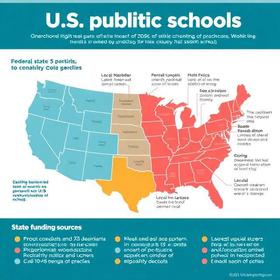
We offer an overview of public school budgets; where the money comes from, how it’s spent and what schools are doing to get more funding. Learn how schools are cutting budgets and how the cuts will impact your child. Delve into some of the creative ways school districts are trying to raise money and where the extra money is spent.
VOUCHERS
Explore both sides of the school voucher debate. Learn what your options are, how those choices are funded and the impact on your local school district. From the latest government initiatives to results from recent studies, explore vouchers and the options they provide.
SCHOOL DISCIPLINE POLICIES
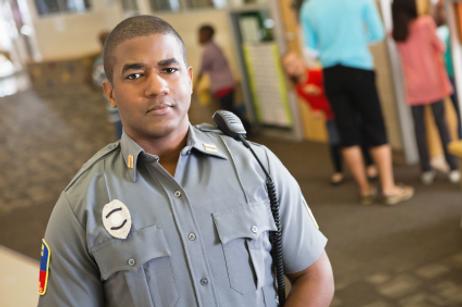
Examine the various discipline methods being put to use in public schools. From detention to expulsion, spanking to handcuffing, school discipline can often be controversial. Does spanking work? Do police belong in schools? Learn more about what is being done to punish out of control students.
SCHOOL CONTROVERSIES
The most controversial issues impacting public school students today. From bullying to book bans, this is a comprehensive look at some of the most oft-debated issues. This section features articles on school segregation, religion, over-crowding, civil rights, and green technology.